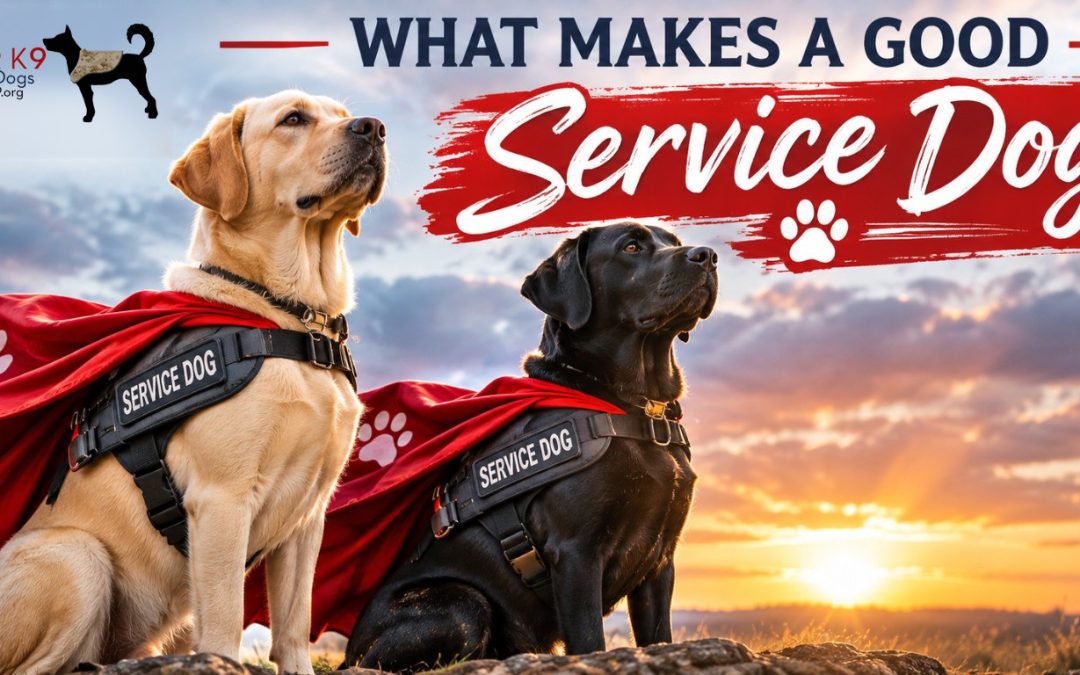
Not every good dog is meant to be a service dog. And that’s okay.
At Semper K9 Assistance Dogs, we regularly receive inquiries from individuals hoping to donate a dog to our service dog training program. Many describe their dogs as incredibly smart, eager to learn, or full of potential.
But sometimes those descriptions include phrases like:
- “He’s really smart, but he’s bitten someone.”
- “She’s protective and doesn’t like strangers.”
- “He has so much energy and needs a job.”
- “She barks at everything, but she’s very trainable.”
- “He’s aggressive toward other dogs, but he’s great with people he knows.”
While these dogs may be wonderful companions in the right environments, these descriptions raise immediate concerns when evaluating potential service dog candidates.
Intelligence alone does not make a good service dog. Successful service dogs require a specific combination of physical characteristics, health, temperament, trainability, and the ability to work safely in unpredictable public environments.
1. Physical Suitability: The Right Dog for the Right Job
Service dogs perform many different tasks, and their physical requirements depend on the disabilities they are trained to assist.
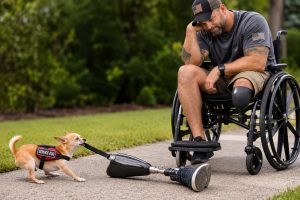
At Semper K9, we provide custom-trained service dogs to disabled American veterans, including veterans who need mobility assistance.
Our dogs may be trained to retrieve an artificial limb, retrieve dropped items, assist with wheelchair-related tasks, or perform carefully evaluated mobility-support tasks.
Because of these responsibilities, physical structure matters.
We typically look for dogs weighing approximately 55 to 100 pounds, although size alone never determines suitability.
A smaller dog may not have the physical characteristics needed for certain mobility tasks. Conversely, an exceptionally large dog can create additional challenges for its handler.
Larger dogs may require more space on public transportation, in restaurants, and in other public settings. They also require more food, potentially more expensive medications, and equipment appropriate for their size.
Our goal isn’t to find the biggest or strongest dog. It’s to find a dog whose physical characteristics appropriately match the veteran’s needs.
For example, a taller veteran requiring certain mobility-related tasks may benefit from a larger dog, while another veteran may be better matched with a smaller, more manageable partner.
2. Why Breed Preferences Matter
Semper K9 does not have blanket breed restrictions. However, we do have breed preferences based on the physical and behavioral demands of our training program.
Labrador Retrievers are among the breeds we frequently consider.
Their typical combination of trainability, retrieving instincts, manageable size, and athletic build can make them well suited for many assistance tasks.
For mobility work, we also evaluate a dog’s musculoskeletal conformation, including its shoulder structure, chest development, limb alignment, and overall orthopedic soundness.
A dog’s ability to safely perform physical tasks depends on much more than its weight or appearance.
Some mobility tasks, particularly those involving pulling, counterbalance, or bracing, can place physical demands on a dog’s body. These tasks require careful consideration of the dog’s orthopedic health, physical maturity, equipment, and veterinary guidance.
Importantly, a service dog should never be expected to function as a substitute for appropriate medical mobility equipment.
We evaluate each potential candidate individually rather than assuming that every dog of a preferred breed will be suitable.
3. Temperament: The Most Important Qualities Can’t Be Measured on a Scale
Even a physically ideal dog may not have the temperament required for service work.
Service dogs must navigate environments that many companion dogs rarely experience.
Imagine accompanying a veteran through a crowded airport, navigating a busy restaurant, riding public transportation, or remaining quietly beside a wheelchair during a medical appointment.
A successful service dog must be able to remain composed, responsive, and focused despite distractions.
At Semper K9, we look for dogs demonstrating qualities such as:
- Emotional stability: The ability to remain composed in unfamiliar environments.
- Confidence: Willingness to encounter new sights, sounds, people, and surfaces without excessive fear.
- Low reactivity: The ability to observe other animals, people, and distractions without inappropriate responses.
- Trainability: A willingness to learn and consistently respond to cues.
- Adaptability: The ability to adjust to different environments and routines.
- An appropriate energy level: Enough motivation to work, combined with the ability to settle calmly for extended periods.
- Sociability and neutrality: Comfort around people and animals without demanding interaction.
Research on assistance dog selection supports the importance of these traits. Studies have associated aggression, high reactivity, excessive excitability, and inappropriate vocalization with lower success rates in assistance dog programs.
4. Why Aggression, Biting, and Excessive Reactivity Are Red Flags
One of the most common misconceptions we encounter is that a dog displaying serious behavioral challenges simply needs a job.
While structured activities, enrichment, and professional training can benefit many dogs, service dog training is not a behavioral rehabilitation program.
A dog with a history of biting, threatening behavior, or significant aggression may pose unacceptable risks in public settings.
Similarly, dogs that bark excessively, react strongly to other dogs, or struggle to recover from stressful experiences may find the demands of service work overwhelming.
This doesn’t mean these dogs are bad dogs.
It means the responsibilities of service work may not be appropriate for their individual behavioral needs.
A dog can be intelligent, affectionate, loyal, and deeply loved while still being unsuitable for service dog training.
Protecting the veteran, the public, and the dog itself must always come first.
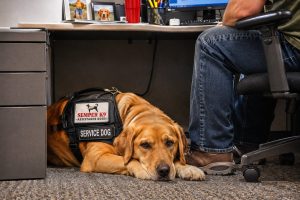
5. The Ability to Settle Is Just as Important as the Ability to Work
People often imagine service dogs constantly performing impressive tasks.
In reality, a significant part of a service dog’s working day may involve doing very little.
A service dog might spend hours resting quietly beneath a restaurant table, sitting through an appointment, or waiting patiently during a family activity.
This requires an important characteristic sometimes called an off switch: the ability to transition from active engagement to calm, relaxed behavior.
Dogs that require constant stimulation or struggle to settle may find this aspect of service work particularly difficult.
We aren’t simply looking for dogs that love to work.
We’re looking for dogs that can work when needed and relax when they aren’t.
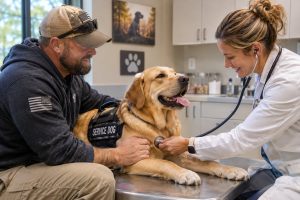 6. Health and Long-Term Working Ability Matter
Service dog training represents a significant investment in an animal expected to perform physically and mentally demanding work.
For this reason, evaluating a candidate’s health is essential.
Depending on the dog’s age, breed, history, and anticipated responsibilities, veterinary screening may include orthopedic evaluations, assessment of joint health, and other examinations appropriate to the individual dog.
Conditions affecting the hips, elbows, spine, or other parts of the musculoskeletal system may influence whether a dog is suitable for particular mobility tasks.
Our responsibility extends beyond determining whether a dog can perform a task today.
We must consider whether that dog can perform its work comfortably and safely throughout its working life.
7. A Great Pet Doesn’t Always Make a Great Service Dog
Some of the most wonderful family dogs would struggle with the expectations placed on a working service dog.
And that’s perfectly acceptable.
At Semper K9, we believe selecting the right candidates is one of the most important responsibilities we have.
Our veterans deserve reliable, appropriately trained partners. Our dogs deserve work that suits their physical and emotional capabilities.
That’s why we evaluate more than intelligence, enthusiasm, or a willingness to learn.
We’re looking for the right combination of health, structure, temperament, trainability, and long-term suitability.
Because the goal isn’t simply to train a dog to perform tasks.
It’s to develop a safe, successful, and lasting partnership between a disabled American veteran and a service dog prepared for the responsibilities ahead.
To contribute to Semper K9 Assistance Dogs and our mission to provide custom-trained service dogs to disabled American veterans at no cost, visit donate.semperk9.org.